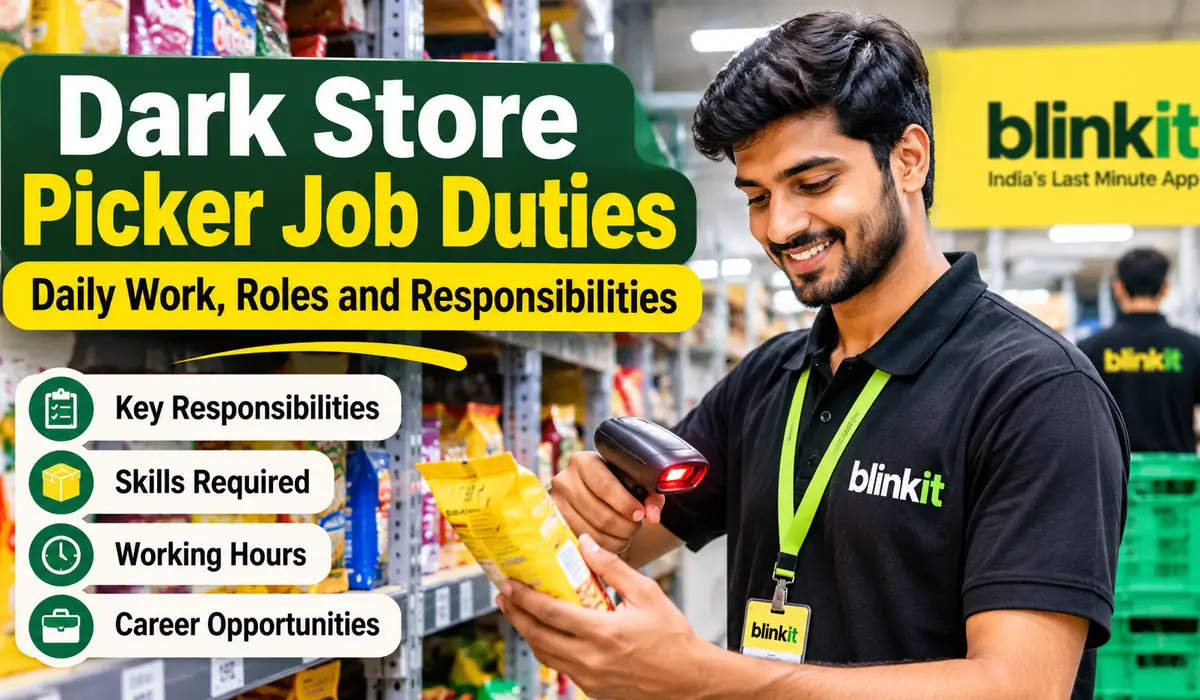
When someone places an order through a quick commerce app, several activities take place inside the dark store before the products reach the customer. One of the people responsible for this process is the dark store picker.
A picker collects products from designated shelves, checks the items against the customer’s order and ensures that the selected products are ready for the next stage of fulfilment.
For people interested in working in quick commerce, understanding the actual duties of a picker is important before applying for a job. The role involves more than walking around and collecting groceries. It requires product identification, attention to detail, basic technology skills and the ability to work in a time-sensitive environment.
This guide explains what a dark store picker does, how the daily process works and what candidates should expect from the job.
What Is a Dark Store Picker?
A dark store picker is an employee responsible for collecting products from storage shelves after receiving an online customer order.
A dark store is a retail fulfilment facility designed primarily to process online orders rather than serve regular walk-in shoppers.
For example, when a customer orders milk, bread, cooking oil and household products through a quick commerce application, the order is sent to a nearby fulfilment store. A picker receives the order details on a handheld device or mobile application and collects the required items from their assigned locations.
Once picking is complete, the order moves to the next stage, which may involve checking, packing and dispatch.
The picker therefore plays an important role in ensuring that customers receive the correct products.

10 Important Dark Store Picker Job Duties
The responsibilities of a picker can vary between companies and store formats. However, the following duties are common across many quick commerce operations.
1. Receiving and Understanding Customer Orders
The first responsibility is to check the order assigned through the store’s picking system.
The picker needs to understand:
- Product names and descriptions.
- Required quantities.
- Product variants and pack sizes.
- Picking instructions displayed on the device.
- Any special instructions available in the system.
Reading the order correctly is important because similar-looking products can have different brands, sizes or specifications.
2. Locating Products on Shelves
Products inside a dark store are arranged in designated racks, shelves or storage locations.
The picker follows the assigned picking route or location information to find each product.
For example, an order may contain a 500 ml bottle of cooking oil and a 1 litre bottle of the same brand. Selecting the correct pack size is essential.
A picker should become familiar with:
- Shelf and rack locations.
- Product categories.
- Storage arrangements.
- Frequently ordered products.
- Special storage requirements.
Good product-location knowledge helps reduce unnecessary movement and picking delays.
3. Picking the Correct Product and Quantity
Selecting the correct product is one of the most important responsibilities.
The picker must check the product name, brand, variant and quantity before collecting it.
Consider an order containing two packets of biscuits. Collecting only one packet or selecting a different flavour can result in an incomplete or incorrect order.
The picker should always follow the order displayed in the system instead of relying on memory.
4. Scanning and Verifying Products
Many quick commerce stores use barcode scanning or digital verification during the picking process.
The picker may need to scan each product to confirm that it matches the order.
This process helps identify:
- Incorrect product selection.
- Wrong pack sizes.
- Barcode mismatches.
- Quantity errors.
- Products that are not recognised by the system.
If a barcode does not scan or the displayed product details do not match, the picker should follow the approved troubleshooting process or inform the supervisor.
5. Checking Product Condition and Expiry Dates
Customers expect to receive products in acceptable condition.
During picking, employees should pay attention to visible product damage and packaging quality. Where required by the company’s SOP, they should also check expiry dates and product freshness.
Examples of issues to identify include:
- Damaged packaging.
- Leaking liquid products.
- Broken containers.
- Expired products.
- Poor-quality or unsuitable fresh items.
A product that does not meet the store’s quality requirements should be handled according to the rejection procedure.
6. Reporting Missing or Unavailable Products
Sometimes a product appears available in the application but cannot be found at its assigned shelf location.
This can happen because of misplaced stock, incorrect inventory records, damaged products or delays in stock updates.
The picker should:
- Recheck the assigned location.
- Check an alternative location if permitted.
- Inform the supervisor or concerned team.
- Follow the approved out-of-stock procedure.
- Update the order only through the authorised system process.
Pickers should not independently replace products with alternatives unless the company procedure permits it.
7. Completing Orders Within the Required Time
Quick commerce stores operate with time-sensitive fulfilment processes.
Pickers are expected to complete assigned orders efficiently while maintaining product accuracy.
Their work may be monitored through operational measurements such as picking time, order completion and picking errors.
However, working faster should not mean ignoring product checks. Selecting the wrong product can lead to customer dissatisfaction, refunds and additional work for the store team.
A good picker balances speed with accuracy.
8. Handing Over Completed Orders
After collecting all products, the picker completes the order in the designated picking system and transfers the items to the next stage.
Depending on the store’s process, this may involve:
- Placing products in the assigned order area.
- Confirming picking completion in the application.
- Keeping different customer orders separate.
- Informing the packing or dispatch team.
- Following the required handover procedure.
Proper handover prevents products from being mixed between customer orders.
9. Supporting Store Organisation and Replenishment
Although picking is the primary responsibility, employees may also need to report operational problems inside the store.
For example, a picker may notice that a frequently ordered product is missing from its assigned shelf even though stock is available elsewhere.
The picker should communicate this to the replenishment or inventory team.
Other responsibilities may include:
- Reporting empty shelf locations.
- Identifying misplaced products.
- Keeping picking areas clear.
- Returning products to the correct locations when instructed.
- Informing supervisors about damaged racks or storage areas.
These activities help maintain a better organised fulfilment environment.
10. Following Safety and Store SOPs
Pickers work in an environment where they may regularly walk, bend, lift and handle different types of products.
They must follow workplace safety instructions and company procedures.
Important practices include:
- Handling heavy products carefully.
- Using equipment only as instructed.
- Keeping aisles and emergency exits clear.
- Following hygiene requirements.
- Reporting unsafe conditions.
- Handling fragile and temperature-sensitive products appropriately.
Following SOPs helps protect employees and maintain smooth store operations.
How Does a Dark Store Picker Spend a Typical Day?
A picker generally performs different activities during a shift. The exact routine depends on the store’s order volume, staffing and operating procedures.
| Stage | Work activity |
|---|---|
| Shift start | Attendance and operational briefing |
| Order allocation | Receiving orders through the picking system |
| Product selection | Locating and collecting items |
| Verification | Scanning and checking products |
| Order completion | Confirming the picked order |
| Handover | Transferring products to the next process |
| Store support | Reporting missing stock and maintaining organisation |
| Shift handover | Following supervisor instructions and completing pending work |
During busy periods, pickers may receive orders continuously. During quieter periods, they may also be asked to support store organisation or other permitted operational activities.
Skills Required for a Dark Store Picker Job
Most entry-level picker roles focus on practical abilities rather than advanced qualifications. However, candidates should understand the following skills before applying.
Basic smartphone knowledge: Pickers generally work with handheld devices or applications. They should be comfortable reading instructions and following digital workflows.
Attention to detail: The ability to identify the correct brand, variant, size and quantity is essential.
Time management: Pickers need to complete orders within operational expectations without compromising accuracy.
Physical fitness: The job may involve prolonged standing, walking, bending and handling products.
Teamwork: Coordination with supervisors, packers, inventory employees and delivery staff supports smooth operations.
Discipline: Attendance, punctuality, hygiene and following store procedures are important parts of the role.
How Is Picker Performance Measured?
A dark store may monitor picker performance through different operational indicators. These measurements vary by company and should not be confused with universal industry standards.
| Performance indicator | What it means |
|---|---|
| Picking accuracy | Correct products and quantities selected |
| Picking time | Time taken to complete assigned picking |
| Order completion | Successful completion of allocated tasks |
| Product handling | Care taken while selecting and moving products |
| Attendance | Punctuality and shift discipline |
| SOP compliance | Following the store’s operating procedures |
For example, repeatedly selecting the wrong product can affect picking accuracy even if the picker completes orders quickly.
Good performance requires a balance between productivity, accuracy and customer experience.
Difference Between a Dark Store Picker and Packer
Picker and packer are separate responsibilities in many fulfilment facilities, although some employers may combine the roles.
| Picker | Packer |
|---|---|
| Collects products from shelves | Prepares collected products for dispatch |
| Follows the picking list | Checks products during packing |
| Scans or verifies selected items | Uses appropriate packing materials |
| Reports missing products | Reports packing or product-condition issues |
| Focuses on correct product selection | Focuses on safe and accurate packing |
The division of work depends on the store’s operating model.
What Should You Know Before Joining as a Picker?
Before accepting a dark store picker position, candidates should understand the working conditions rather than focusing only on the job title.
Ask the recruiter or employer about:
- Actual job location.
- Daily working hours.
- Morning, afternoon or night shifts.
- Weekly off arrangements.
- Salary structure and payment date.
- Incentives, if applicable.
- Employment type and probation period.
- Physical responsibilities.
- Training and joining requirements.
These details may differ between companies, cities and individual stores.
Candidates should also verify job offers through official company channels or trusted recruitment sources. Avoid paying unverified recruiters for a guaranteed job.
Where to Apply for Dark Store Picker Jobs in India
Job portals and quick commerce career pages
| Website / Company | Job opportunities | Application link |
|---|---|---|
| Apna | Picker, packer, warehouse associate and store jobs | Search Picker/Packer Jobs |
| WorkIndia | Local picker, packing and warehouse vacancies | Search Jobs |
| Indeed India | Picker, warehouse and fulfilment jobs | Visit Indeed |
| National Career Service (NCS) | Government-supported employment listings | Visit NCS |
| Blinkit Careers | Retail, warehouse and corporate opportunities | Official Careers |
| Zepto Careers | Operations and other company vacancies | Official Careers |
| Swiggy Careers | Instamart warehouse, operations and other roles | Explore Jobs |
Frequently Asked Questions
Is a dark store picker responsible for delivery?
No. A picker generally works inside the dark store and prepares customer orders. Delivery riders collect ready orders and transport them to customers.
Does a picker need previous retail experience?
Not necessarily. Some entry-level positions
Hi!, Linda here, I’m a foodie, love shopping & sharing experiences with others. I worked in retail stores for the past 15. Currently working as Customer service manager with one of the reputed retail companies in Florida.